Blog
The Fergana Valley — the Heart of Uzbek Textile Art

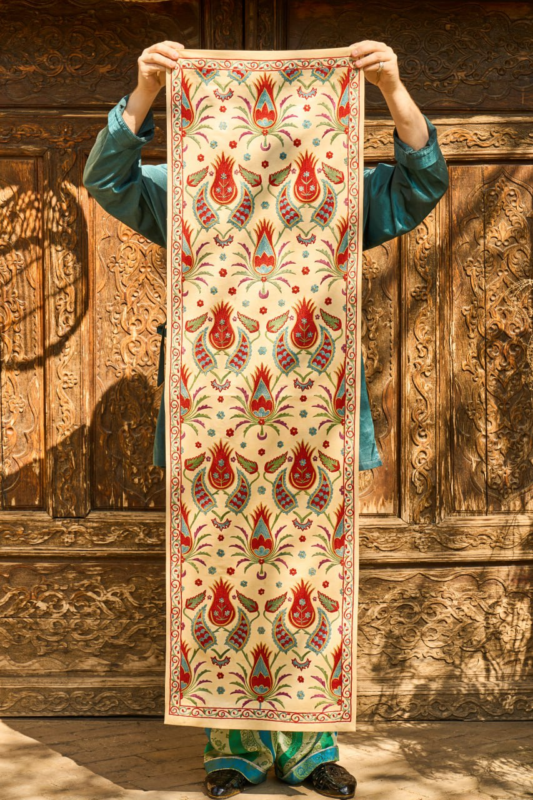
The Fergana Valley has long been regarded as the heart of Uzbek textile art. For centuries, traditions of silk weaving and refined embroidery have flourished here. The Fergana school is distinguished by its lightness and elegance: its ornaments breathe with air and space, unlike the dense and richly saturated compositions of Bukhara or Samarkand suzani. Artisans embroider on deep green, violet, or brown satin, using threads of natural silk or cotton dyed with plant-based pigments.
One of the most prominent contemporary masters is Abdulkhakim Tadjibayev from Namangan. He carries forward a family tradition now in its third generation. For more than twenty-six years, Abdulkhakim has been creating artistic embroidered works — suzani, table runners, cushion covers, jackets, chapans, and accessories. In all of his creations, the master uses only natural materials and traditional dyeing techniques, employing pomegranate peels, walnut shells, and the leaves of isparak and tukhmak plants.
Since 2000, he has been a member of the Hunarmand Association of Craftspeople of Uzbekistan.
In 2019, he was awarded the title “Master of the Year” at the national competition Tashabbus-2019.